


Introduction: Leverage Automated Calling to Accelerate Business Growth
For small businesses and start-ups in India, reaching new customers by phone is an important way to get leads and make sales. However, manually dialing each number is time-consuming and inefficient, particularly when a significant portion of calls go unanswered.
Auto dialer software addresses these challenges by streamlining the outbound calling process.
This technology enhances team productivity by automatically dialing multiple numbers, connecting answered calls to available agents, and logging outcomes in real time. It reduces idle time, increases call volume, and allows businesses to engage with more customers efficiently.
This article explains how auto dialer software can help small businesses in India. It shows how this software can help them grow and connect with more people.
What Is Auto Dialer Software?
Auto dialer software is an advanced calling solution designed to automate the process of contacting leads or customers. Utilizing this tool eliminates the need for manual dialing.
Key functionalities include:
- Automatically calling a series of phone numbers in sequence
- Directly connecting live calls to available agents
- Capturing and storing call-related data and notes
- Integrating with Customer Relationship Management (CRM) systems for centralized recordkeeping
Auto dialer software is particularly valuable for:
- Cold calling campaigns
- Lead verification
- Customer follow-ups
- Sales and promotional outreach
It supports the following dialing modes:
- Predictive Dialing: Initiates multiple calls based on agent availability to maximize efficiency
- Progressive Dialing: Places a call only when an agent is available
- Power Dialing: Empowers agents to manually launch the next call at their discretion
Why Auto Dialer Software Is Essential for Indian Start-Ups
India’s start-up ecosystem—including businesses in Tier 2 and Tier 3 cities—often relies heavily on phone communication to engage with potential customers. However, using manual processes presents numerous wasted efforts.
Common operational challenges include:
- Inadequate number of sales professionals
- Time lost on unanswered or invalid calls
- Poor tracking of call outcomes
- Unorganized lead data
Auto dialer software mitigates these issues by streamlining call logistics, maintaining organized data, and enhancing daily productivity across teams.
Case Study:
A Jaipur-based education technology company aimed to contact 5,000 students weekly. By using NeoDove’s auto dialer with WhatsApp, the company boosted successful call connections by 35%. They also raised enrollment rates by 22% without needing more staff.
10 Essential Features to Consider in Auto Dialer Software
1. Predictive Dialing
- Dials multiple numbers smartly, connecting only answered calls
- Optimizes agent efficiency and reduces wait times
2. Progressive Dialing
- Initiates calls one at a time based on agent availability
- Ideal for smaller or precision-focused teams
3. Power Dialing
- Allows agents to control call pacing
- Suitable for high-intent, personalized calling campaigns
4. Call Recording
- Archives call for performance reviews, training, and compliance audits
5. CRM Integration
- Seamlessly work with platform such as NeoDove CRM
- Synchronizes call activity with lead and customer records
6. Real-time Analytics
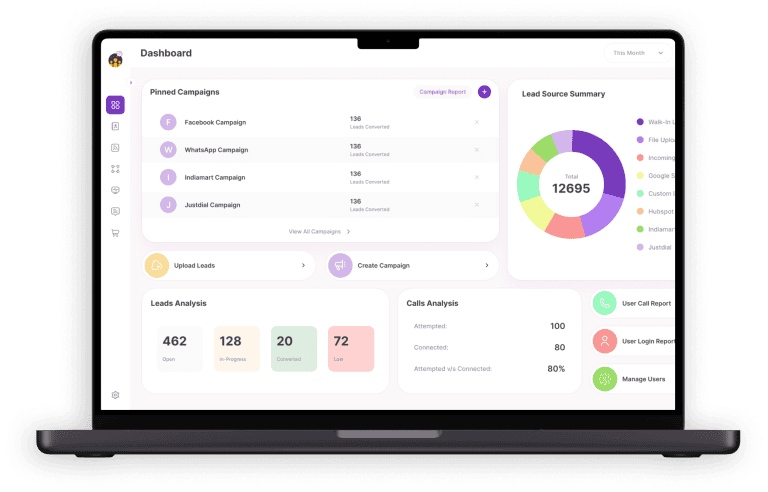
- Displays dashboards illustrating call volumes, success rates, and agent performance
7. Call Disposition Notes
- Enables agents to categorize outcomes like “Not Interested,” “Call Back Later”
8. Scheduled Callbacks
- Automatically redials missed contacts at optimal times
9. Local Caller ID (CLIP)
- Displays region-specific caller IDs
- Improves pick-up rates by appearing more familiar to recipients
10. Cloud-Based and Mobile-Enabled
- Accessible via web browsers and smartphones
- Requires no complex hardware or on-premise infrastructure
7 Key Benefits of Auto Dialer Software
1. Increased Agent Productivity
- Automating the dialing process enables teams to complete significantly more calls each day.
2. Higher Response Rates
- Features like local numbers and time-optimized retries help maximize the number of answered calls.
3. Quality Monitoring and Performance Coaching
- Managers can review recorded calls to provide targeted feedback and improve agent capabilities.
4. Rapid Market Penetration
- Ideal for high-volume campaigns such as product launches or time-sensitive promotions.
5. Cost Efficiency
- A single agent leveraging automation can achieve the output of multiple manually dialing agents.
6. Streamlined Data Management
- Automatic logging of all call activity ensures accurate recordkeeping and reduces administrative burden.
7. Scalable Infrastructure
- Additional agents and new campaigns can be launched quickly, with minimal overhead.
How to Select the Right Auto Dialer in Seven Structured Steps
1. Define Your Primary Objective
Determine whether your team will focus on cold outreach, lead credentials, or customer surveys.
This goal will guide the selection of appropriate features.
2. Assess Team Size
- Large teams benefit from predictive dialing
- Mid-sized teams should consider progressive options
- Small teams may be best served by power dialers
3. Opt for a Cloud-Based Solution
Avoid systems that require local hardware. Prioritize flexible platforms accessible from any location.
4. Confirm CRM Compatibility
Ensure the solution integrates with sales funnels across platforms such as WhatsApp, web forms, and Facebook.
5. Utilize Free Trials
Test leading platforms—such as NeoDove—before committing to long-term plans.
6. Prioritize Ease of Use
Choose systems with a clear interface and support for multiple regional languages to reduce onboarding time.
7. Ensure Compliance
Verify that the system adheres to all relevant regulations, including blocking calls to DND Compliance with TRAI regulations and DND numbers.
Case Studies from Indian Start-Ups
- Health Technology Start-Up – Pune: I switched from using Excel to auto-dialing for managing leads. This change led to an 800% increase in gaining new customers.
- Logistics Application – Bangalore: Reduced unproductive call time by 38%, acquiring delivery partners more efficiently.
- FinTech Firm – Gurugram: Improved loan conversion rates by 50% through scheduled reminders and efficient workflows.
- EdTech Enterprise – Bihar/UP: Applied local caller ID (CLIP) technology and more than doubled call pick-up rates.
Common Challenges and Practical Solutions
- Lack of Technical Proficiency: Opt for user-friendly platforms with multilingual interfaces.
- Unstable Internet Connectivity: Choose cloud systems offering offline calling or call buffering features.
- High Call Drop Rates: Calibrate the predictive dialer speed to match real-time agent availability.
- Regulatory Compliance: Ensure the software filters DND numbers and adheres to TRAI guidelines.
- Disorganized Lead Lists: Use a CRM-driven tool that automatically updates lead statuses after each call.
- Data Privacy Risks: Select platforms that implement data encryption, password protection, and access controls.
- Overly Complex Interfaces: Favor products designed for non-technical users with intuitive navigation.
12 Best Practices to Optimize Auto Dialer Use
- Regularly clean databases by removing duplicate contacts
- Segment contact lists by location or campaign type
- Activate local caller ID (CLIP) to increase response rates
- Provide agents with clear, concise call scripts
- Schedule calls during peak availability hours (avoid 1–3 PM and post-9 PM)
- Attempt at least three contact attempts per lead
- Encourage agents to log call outcomes promptly
- Monitor analytics to identify top-performing agents
- Follow up missed calls with WhatsApp messages
- Recognize employee achievements to boost morale
- Record and review calls—with consent—for training purposes
- Evaluate campaign outcomes weekly to refine strategy
Why NeoDove Is an Effective Choice for Indian Start-Ups
NeoDove offers a tailored auto dialer solution specifically designed for the Indian market. Standalone details, demo availability, integrations, and pricing info should be presented here based on organizational content strategy.