

















Join our WhatsApp Channel for the latest updates.
Table of Contents
ToggleKey Takeaways
Education is evolving faster than ever, with technology playing a pivotal role in reshaping how students learn and interact.
Among the many innovations, conversational AI has emerged as a game-changer. It’s transforming classrooms, bridging learning gaps, and personalizing education like never before. But how is AI being applied in education today?
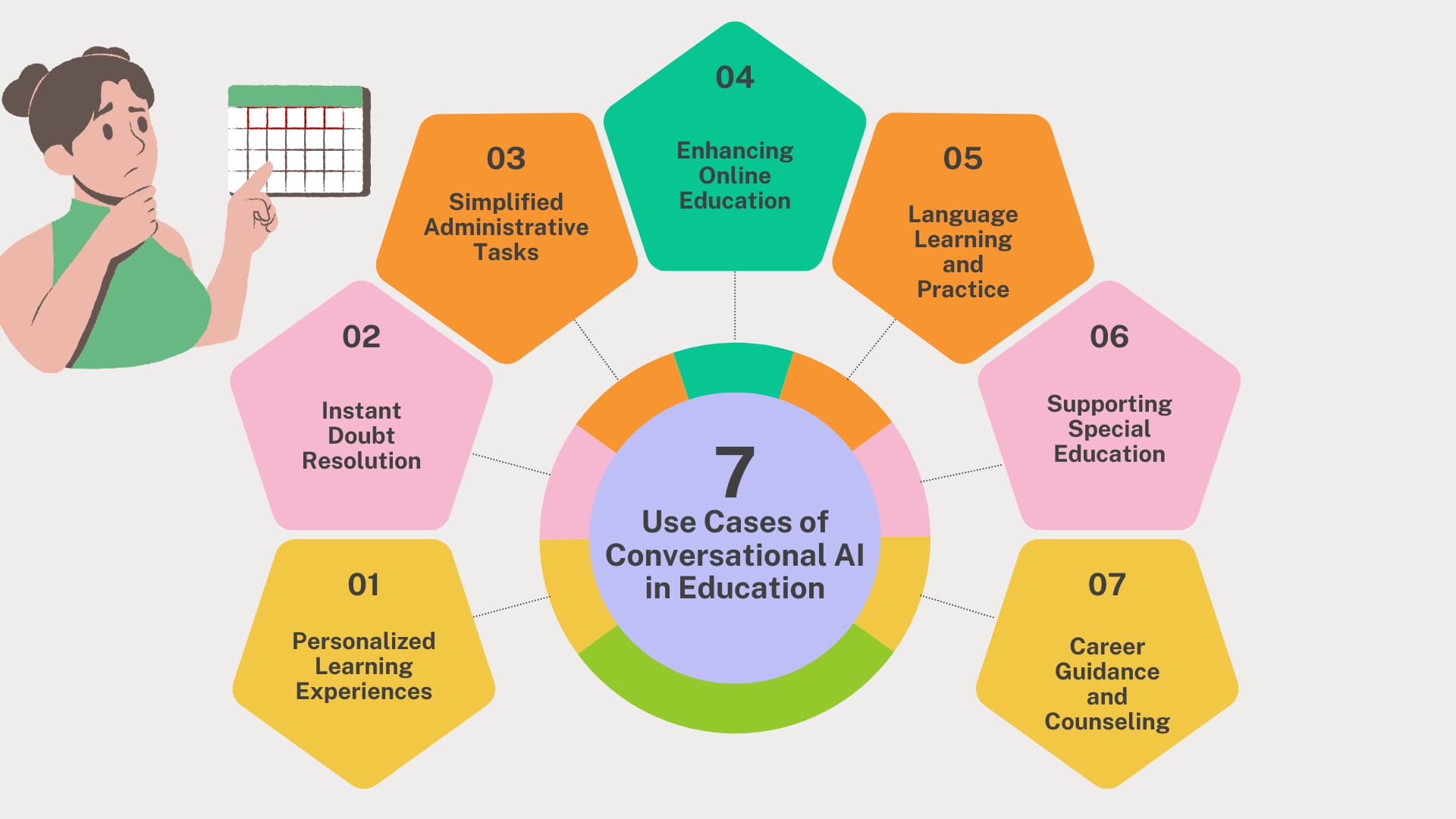
This blog dives into the top seven use cases of conversational AI in education in 2024. Along the way, we’ll explore real-life examples and practical tips to leverage its potential effectively.
Conversational AI in Education refers to the use of artificial intelligence-powered technologies, such as chatbots and virtual assistants, to facilitate communication and enhance learning experiences.
These systems are designed to simulate human-like interactions, making education more accessible, engaging, and efficient.
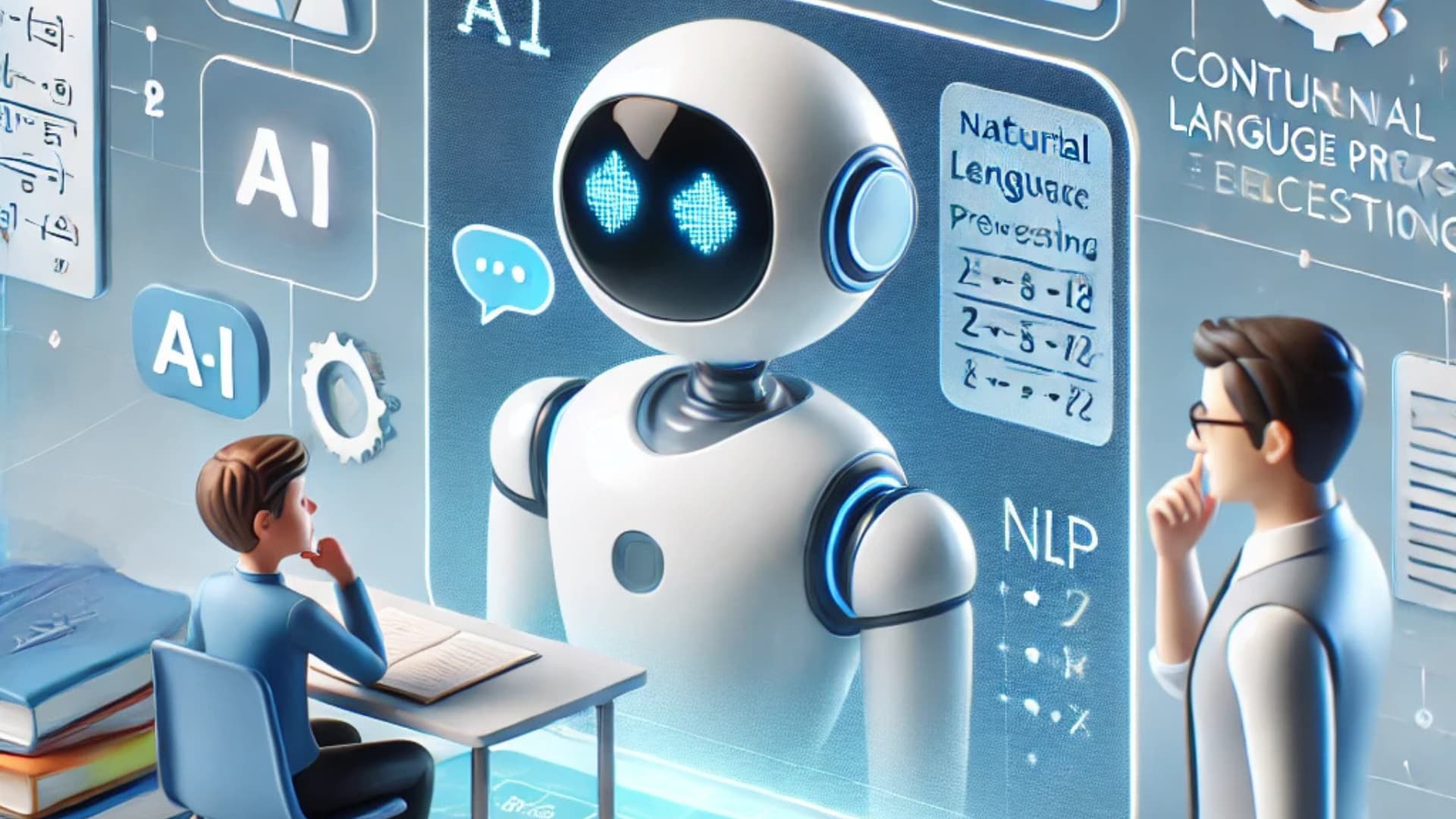
By leveraging natural language processing (NLP) and machine learning, conversational AI can assist students and educators in various ways, such as answering queries, providing personalized learning recommendations, and automating routine administrative tasks.
Whether it’s helping a student solve a math problem at midnight or guiding them through complex topics, conversational AI ensures instant support and adaptability, revolutionizing how education is delivered.
AI’s capacity to customize lessons for each student is among its most impressive educational benefits. Conversational AI systems analyze a learner’s pace, strengths, and weaknesses, providing personalized recommendations.
For instance, platforms like Duolingo use AI to adapt language lessons based on a learner’s responses. If a student struggles with verb conjugation, the system dynamically adjusts to offer more practice in that area.
In addition to increasing engagement, this tailored strategy raises retention rates. Teachers can also use these insights to fine-tune their classroom strategies, bridging gaps in real-time.
Tip – Use AI platforms like Duolingo to identify learning gaps and strengthen weak areas with customized practice.
Remember the frustration of waiting for hours—or days—for your teacher’s response to a pressing question? Conversational AI eliminates this bottleneck. AI-powered chatbots like IBM Watson or ChatGPT provide instant, 24/7 doubt resolution.
In the education sector, this feature proves invaluable for online learning environments where students might not have direct access to instructors.
Whether solving a tricky math problem or understanding a complex science concept, AI and chatbots in education ensure that no question goes unanswered.
Tip – Integrate AI chatbots in your learning platform to ensure students have 24/7 access to instant answers.
From grading assignments to tracking attendance, these tasks take up precious time that could otherwise be spent teaching.
Here’s where the use of AI in education shines. Conversational AI can automate routine administrative tasks. For instance, chatbots can handle student inquiries about schedules, deadlines, or course details, while AI-powered systems can grade assignments with minimal human intervention.
A real-world example? Riiid, an AI platform, uses machine learning to assess tests quickly and provide actionable feedback.
Tip – Automate routine tasks like grading and scheduling with AI tools to save time for teaching.
With the rise of remote learning, conversational AI plays a critical role in ensuring a seamless online education experience. By mimicking human-like interactions, AI chatbots keep students engaged, motivated, and on track.
Take Coursera, for example. It employs conversational AI to guide learners through courses, suggest resources, and track progress.
This application of AI in online education creates a virtual learning assistant that enhances both convenience and engagement.
Tip – Leverage AI chatbots to boost engagement and guide students effectively in remote learning environments.
Learning a new language requires consistent practice and feedback. Conversational AI fills this gap by simulating real-world conversations.
AI-powered platforms like Babbel and Rosetta Stone offer chat-based language practice, allowing students to refine their skills at their own pace.
For example, a student learning French can practice speaking with an AI chatbot, receiving instant corrections on grammar, pronunciation, and fluency.
The impact of AI in education here is immense, as it democratizes access to language learning tools, making them affordable and widely accessible.
Tip – Practice conversations with AI-powered language tools to improve fluency and gain real-time feedback.
One of the most heartwarming use cases of AI in education is its role in supporting students with disabilities. Conversational AI tools are breaking barriers for those with visual, auditory, or learning challenges.
Take Microsoft’s Seeing AI, a tool designed to assist visually impaired students. By narrating text or describing surroundings, it empowers students to navigate their learning journey independently.
Similarly, AI chatbots can help autistic learners by simulating social interactions in a controlled environment.
This application highlights the future of AI in education as inclusive, accessible, and empowering for every learner, regardless of their abilities.
Tip – Use AI solutions like Seeing AI to create an inclusive and accessible learning environment for all students.
Choosing the right career path can be overwhelming for students. Conversational AI tools step in to offer personalized guidance based on a student’s strengths, interests, and academic performance.
Platforms like Unibuddy use AI to connect students with alumni or advisors who can answer career-related questions.
By analyzing a student’s preferences and goals, these tools recommend suitable courses, universities, and even extracurricular activities.
Tip – Turn to AI-powered platforms for personalized career recommendations and mentorship opportunities.
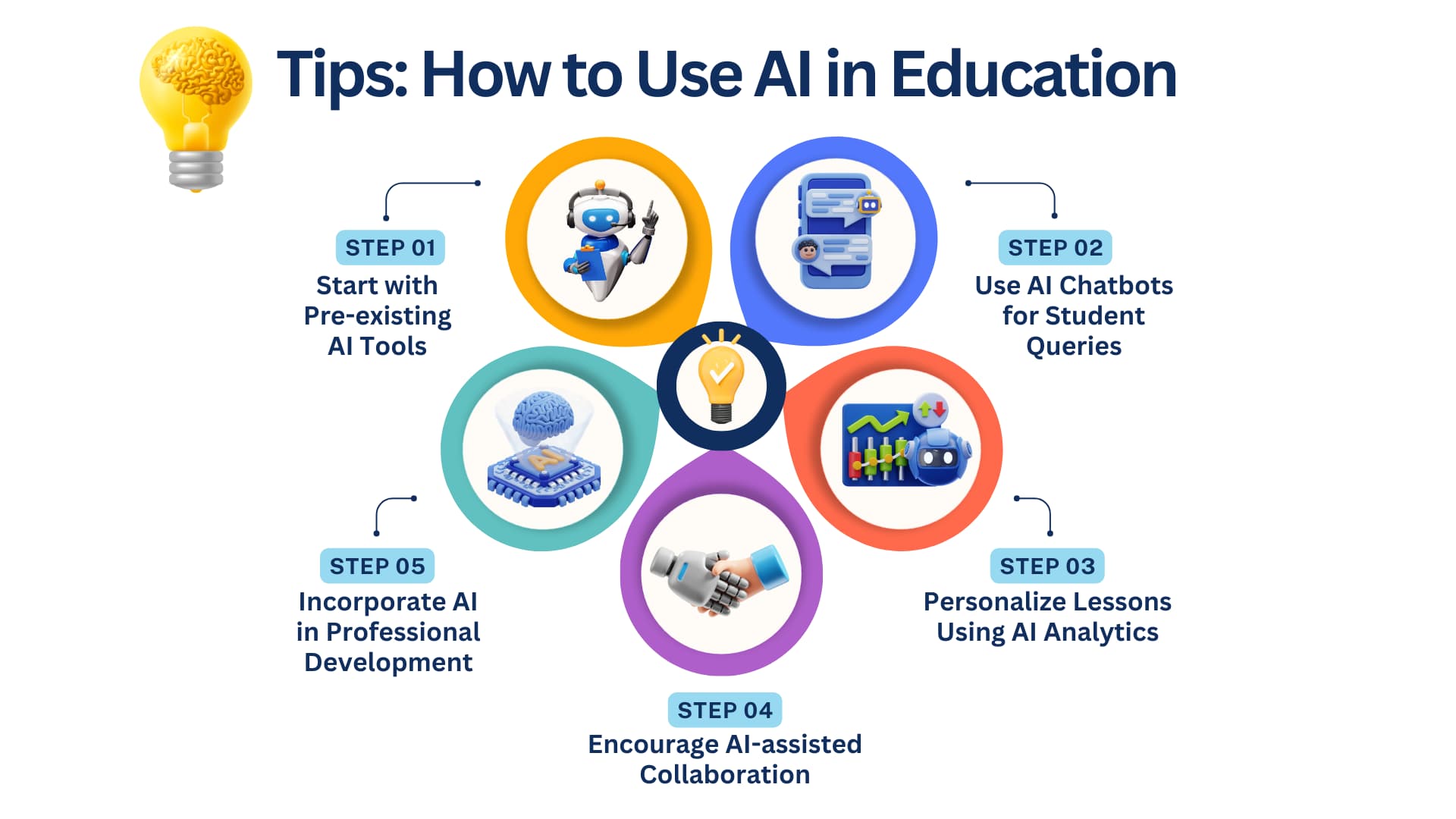
Begin your journey with platforms that already incorporate AI, such as Duolingo, Quizlet, or Khan Academy. These tools are user-friendly and designed for both educators and students.
For instance, Khan Academy’s AI tutor can guide learners through complex topics with ease. By familiarizing yourself with these platforms, you can quickly understand how AI enhances learning experiences.
AI chatbots are perfect for answering repetitive questions about assignments, schedules, or course material.
Teachers can implement chatbots like Edmodo or Ivy.ai to provide instant responses, freeing up time for personalized teaching.
These bots can even guide students through course selections or address technical issues in online learning environments.
Leverage the analytics features of AI-powered platforms to gain insights into student performance.
Tools like Classcraft or DreamBox Learning analyze each student’s progress and recommend tailored lesson plans.
This personalization ensures every learner gets the attention and resources they need to excel.
AI doesn’t just benefit individual learners; it can foster collaboration too. For example, tools like Google’s Socratic app can help groups of students solve problems together by suggesting relevant resources and ideas.
Teachers can assign group projects where AI tools assist in brainstorming or research, making learning more interactive and engaging.
Teachers and administrators should also embrace AI to enhance their professional skills. Platforms like Coursera or Udemy offer AI-powered courses for educators, focusing on how to use AI in education effectively.
These courses teach strategies for implementing AI tools, understanding their limitations, and maximizing their benefits.
As we look ahead, the future of AI in education promises even more groundbreaking developments. From virtual reality classrooms to predictive analytics that foresee learning challenges, the possibilities are endless.
However, it’s important to strike a balance. While conversational AI is a powerful ally, it should complement—not replace—the human touch in teaching. After all, education is as much about emotional connection as it is about knowledge transfer.
The impact of AI in education in 2024 is undeniable. Conversational AI is not just a buzzword—it’s a transformative tool reshaping how we teach, learn, and grow.
Whether it’s personalizing lessons, automating tasks, or supporting special education, the advantages of AI in education are vast and varied.
By embracing these innovations and learning how AI is used in education, educators and institutions can create a more inclusive, efficient, and engaging learning experience for all.
The future of education is here—are you ready to be a part of it?
AI in education refers to the application of artificial intelligence tools like chatbots, virtual assistants, and adaptive learning platforms to improve teaching and learning experiences.
AI analyzes a student’s learning style, pace, and weaknesses to create tailored lesson plans and recommendations, ensuring a more effective learning process.
Key advantages include personalized learning, instant doubt resolution, enhanced administrative efficiency, improved accessibility, and better student engagement.
AI powers virtual tutors, chatbots for answering queries, and analytics tools that track progress, ensuring an interactive and productive remote learning experience.
AI tools like Seeing AI assist students with disabilities by providing accessible features like text-to-speech, social simulations, and more, fostering inclusivity.
The future of AI in education lies in further automating administrative tasks, offering deeper personalization, supporting educators with advanced analytics, and ensuring global access to quality education.

100% Lead Capture, 75% More Efficiency, 2X Engagement!
Book a free demo and see how you can close more deals, faster!


95% business who use NeoDove report 3x more profits!
Happy Customers
107k reviews


Book a free demo and see how you can close more deals, faster!

![]()
95% business who use NeoDove report 3x more profits!
Happy Customers
107k reviews

These outcomes and beyond can be yours.
Lead Leakage
Increase in call attempts
More Engagement