



















Join our WhatsApp Channel for the latest updates.
Table of Contents
ToggleTired of generic marketing campaigns that don’t yield results?
In today’s competitive landscape, account-based marketing (ABM) is the key to reaching and engaging your target accounts effectively.
If you’re curious about what ABM is and how it can revolutionize your marketing strategy, you’re in the right place. Let’s dive into the essentials of ABM, its benefits for manufacturers, and some practical examples to help you craft your own ABM plan for manufacturers.
At its essence, account-based marketing is a strategic method that prioritizes specific accounts instead of aiming for a broad audience. Rather than attempting to engage everyone, your marketing initiatives focus on key accounts that are more likely to drive substantial revenue for your business.
By customizing your marketing efforts to the needs and characteristics of these targeted accounts, you can improve engagement and drive conversions.
ABM in manufacturing involves crafting customized marketing strategies specifically designed for individual accounts. This approach requires a deep understanding of each target account’s pain points, preferences, and decision-making processes.
By gaining these insights, manufacturers can provide personalized content and communication that truly resonates with their prospects. This tailored methodology not only aids in nurturing leads but also reinforces relationships with existing clients, fostering loyalty and trust in the process.
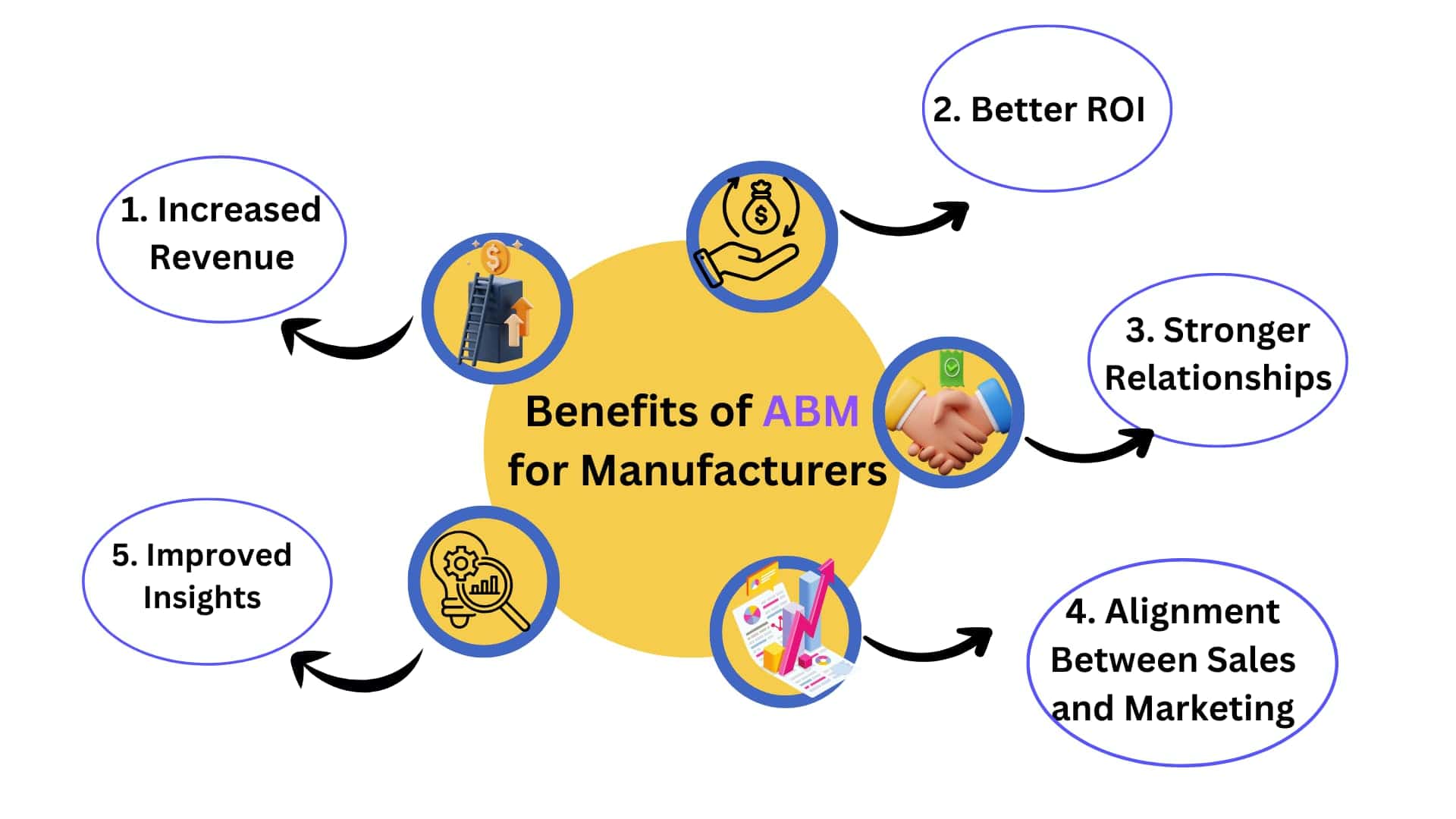
Implementing an Account-Based Marketing (ABM) plan can significantly transform the way manufacturers engage with their clients and drive business growth. Here are the key benefits:
One of the most compelling advantages of ABM is its potential to increase revenue. By concentrating efforts on high-value clients, manufacturers can better tailor their products, services, and communication to meet the specific needs of these accounts. This targeted approach allows for the development of customized solutions that resonate with clients, leading to larger deal sizes.
For instance, when a manufacturer identifies a key account that requires specialized machinery, they can invest time in understanding the unique operational challenges that client faces. This knowledge enables them to propose a solution that addresses those challenges, often resulting in higher sales.
Tip – Focusing on fewer accounts allows sales teams to dedicate more time to nurturing the relationships, leading to improved customer loyalty and repeat business.
ABM often yields a higher return on investment compared to traditional marketing methods. ABM enables manufacturers to utilize their resources more effectively. Instead of spreading their marketing budget across a broad audience, manufacturers can concentrate on accounts that have a higher likelihood of conversion.
By using data analytics, manufacturers can identify which accounts are more profitable and likely to respond positively to marketing efforts.
Tip – With a focused strategy, manufacturers can optimize their campaigns for these accounts, leading to increased efficiency and cost-effectiveness. This results in better lead quality and higher conversion rates, ultimately enhancing the overall ROI.
Building strong relationships with clients is crucial in the manufacturing sector, where long-term contracts and partnerships often drive business. ABM enables this by helping manufacturers to develop a deeper understanding of their target accounts.
For example, sending targeted content that speaks directly to a client’s challenges can significantly enhance engagement. This personalized approach helps manufacturers position themselves as trusted advisors rather than just vendors, fostering loyalty and long-lasting partnerships.
As these relationships strengthen, manufacturers can enjoy not only repeat business but also referrals to other potential high-value clients.
Tip – Through personalized marketing campaigns and tailored communications, manufacturers can address the specific pain points and goals of each account.
ABM encourages collaboration between sales and marketing teams, leading to a more cohesive strategy and better results. When both teams work together towards common goals, they can create a unified message that resonates with target accounts.
For example, marketing can provide sales with insights from previous interactions, such as content engagement and behavioral patterns, which can be crucial during sales pitches. In turn, sales can share feedback with marketing about the effectiveness of campaigns and materials.
Tip – This continuous loop of communication ensures that both sales and marketing teams are aligned, maximizing the impact of ABM initiatives.
ABM empowers manufacturers to gather valuable insights about their target accounts. By monitoring engagement with marketing materials, tracking purchasing behaviors, and analyzing customer feedback, manufacturers can gain a comprehensive understanding of each account’s preferences and needs.
These insights can be leveraged to refine future marketing and sales strategies. For instance, if a manufacturer observes that a specific account frequently engages with content related to sustainability, they can tailor their messaging and product offerings to align with that client’s interests.
Tip – This data-driven approach not only enhances the effectiveness of marketing campaigns but also enables manufacturers to anticipate client needs, further solidifying their position as industry leaders
Ready to develop your ABM marketing plan for manufacturing? To help you begin, here’s a straightforward framework:
Look for clients that align with your ideal customer profile—those that have the potential for high lifetime value and strategic importance to your business.
Understand their business model, challenges, and industry trends. This knowledge will enable you to tailor your marketing efforts effectively.
Now that you know your accounts inside and out, it’s time to create personalized content. This could include case studies, whitepapers, or customized email campaigns. The objective is to deliver value and address the unique challenges faced by each account.
Consider where your target accounts spend their time. Whether it’s LinkedIn, industry-specific forums, or email newsletters, make sure you’re reaching them through the channels they prefer.
Once your campaigns are live, track their performance. Use analytics to measure engagement, conversions, and overall effectiveness. This will help you refine your approach for future campaigns.
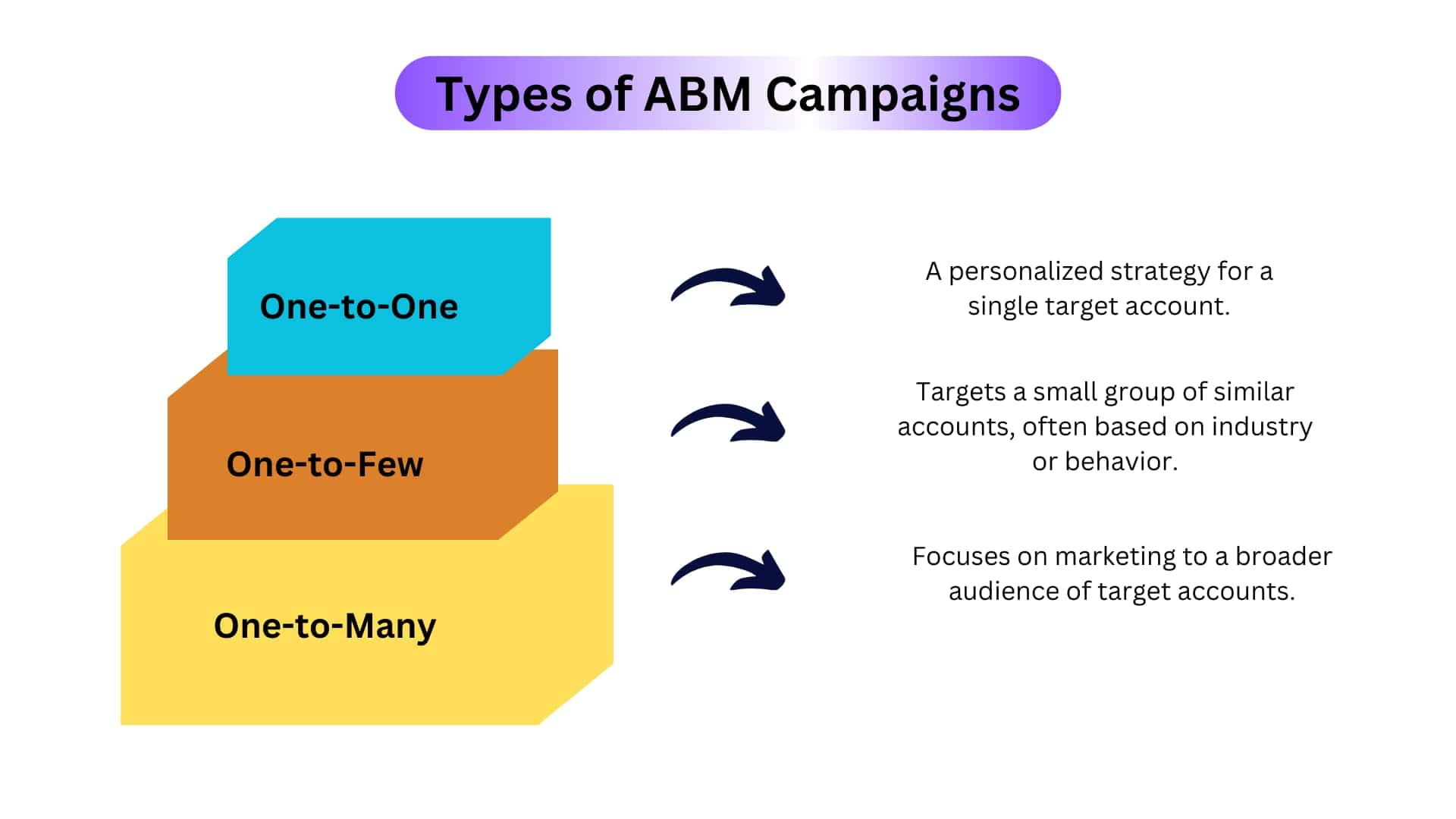
When creating your ABM marketing plan for manufacturing, consider the various types of ABM campaigns you can implement:
One-to-One ABM is a highly personalized approach tailored specifically for a single target account. This method involves in-depth research and a deep understanding of the selected account’s needs, challenges, and business goals.
Marketing efforts are meticulously crafted, focusing on custom content, personalized outreach, and targeted solutions. While resource-intensive, this strategy can lead to significant rewards, such as large contracts and strong, long-lasting relationships with key clients.
Tip – It’s particularly effective for high-value accounts where the potential return justifies the investment
The One-to-Few ABM strategy targets a small group of accounts that share similar characteristics, such as industry or purchasing behavior. Marketing efforts are customized to address the collective needs and preferences of these accounts, allowing for a balance between personalization and efficiency.
Tip – While not as tailored as the One-to-One approach, this strategy still fosters meaningful connections with multiple clients simultaneously and is ideal for manufacturers looking to enhance engagement with select groups of high-potential clients.
One-to-Many ABM involves creating marketing campaigns aimed at a larger audience of target accounts. While this approach sacrifices some level of personalization, it allows manufacturers to achieve greater scalability.
By developing content and messages that resonate with broader themes relevant to the entire target audience, manufacturers can reach more prospects efficiently.
Tip – This strategy works well for products or services with broad applications across multiple sectors, making it an effective option for driving brand awareness and generating leads at scale.
To inspire your ABM strategy, here are a few account-based marketing examples that have worked well in the manufacturing sector:
Hosting industry-specific webinars tailored to the interests and challenges of your target accounts can position your company as a thought leader.
Sending tailored emails that address specific needs or recent developments in a target account’s industry can improve engagement.
Use LinkedIn’s targeting options to reach decision-makers within your target accounts. Create ads that speak directly to their pain points and needs.
Develop detailed case studies that showcase how your products have solved similar challenges for other clients. Customize your approach to showcase solutions that are pertinent to your target accounts.
Creating a structured ABM marketing plan for manufacturing can simplify the process. Here’s a basic template to help you get started:
Summary of insights gathered about each account.
Account-based marketing represents a transformative approach for manufacturers looking to enhance their marketing strategies. By focusing on targeted accounts and tailoring your efforts to their unique needs, you can drive better results and foster stronger relationships.
As you embark on your journey to develop an ABM plan for manufacturers, remember to remain flexible and willing to adapt your strategy based on feedback and performance data. With the right approach, your manufacturing business can thrive in today’s competitive landscape.
ABM is a targeted business strategy that focuses marketing efforts on specific high-value accounts rather than a generalized audience.
Unlike traditional marketing, which targets a wide audience, ABM customizes campaigns for individual accounts to enhance engagement and conversion rates.
Effective ABM campaigns include personalized email outreach, targeted content marketing, and specialized webinars tailored to specific accounts.
Yes, small manufacturers can leverage ABM to focus their resources on high-value clients, resulting in more effective marketing and increased sales.
Start by identifying high-value accounts, developing personalized content, aligning sales and marketing efforts, and measuring the success of your campaigns.

100% Lead Capture, 75% More Efficiency, 2X Engagement!
Book a free demo and see how you can close more deals, faster!


95% business who use NeoDove report 3x more profits!
Happy Customers
107k reviews


Book a free demo and see how you can close more deals, faster!

![]()
95% business who use NeoDove report 3x more profits!
Happy Customers
107k reviews

These outcomes and beyond can be yours.
Lead Leakage
Increase in call attempts
More Engagement