Here are the features you should look for in insurance CRM solutions:
The main purpose of having a CRM is to manage customer relationships, making contact management a crucial feature.
Your insurance CRM software should store customer details like names, contact numbers, email IDs, and their queries. This information is highly beneficial for sales, claims, and support departments to develop scripts or solutions to answer customers efficiently.
The insurance CRM solutions allows you to segment your leads based on criteria like hot, warm, or cold leads. You can also segment them according to age, demographics, etc., to better understand your customers and assign them to the right agent for assistance.
Repetitive tasks like dialing numbers, and sending SMS, emails, or WhatsApp messages can be automated using CRM for insurance agents.
This feature will benefit your team, who continuously dial numbers. You can free up customer-facing teams from manual dialing work, allowing them to focus on satisfying customers.
This, in turn, will boost your revenue as you can reach customers on time and follow up with ease.
Your CRM for insurance agents should support integration. It is essential as you wouldn’t want to switch between platforms for different activities.
For example, if you want to capture leads from Facebook and Google ads, you’d want them to go directly to your CRM instead of having your marketing team download and upload them.
So, this CRM will integrate different platforms, making it easier to manage various platforms and activities simultaneously.
One of the most important features of an insurance CRM company is pipeline management. You will have a clear overview of the sales funnel and where your customer lies in this funnel.
This opens doors for increased opportunities to convert potential leads and ensures no lead slips through the cracks, thereby helping your sales team boost revenue.
Another crucial feature is lead management, which a CRM for insurance agents will offer! This feature helps you manage leads, from capturing them to moving them to your sales team.
Not only that, but you should also be able to tag the leads based on priority. This way, your agents know which list to focus on first and plan their day accordingly.
Look for the team management feature in the CRM for insurance agents. It will allow you to assign work to your agents easily, and set priorities, due dates, and reminders to get the work done.
You can also track how much break your agent takes, their call quality, how many leads they convert, and get overall details about agents’ productivity.
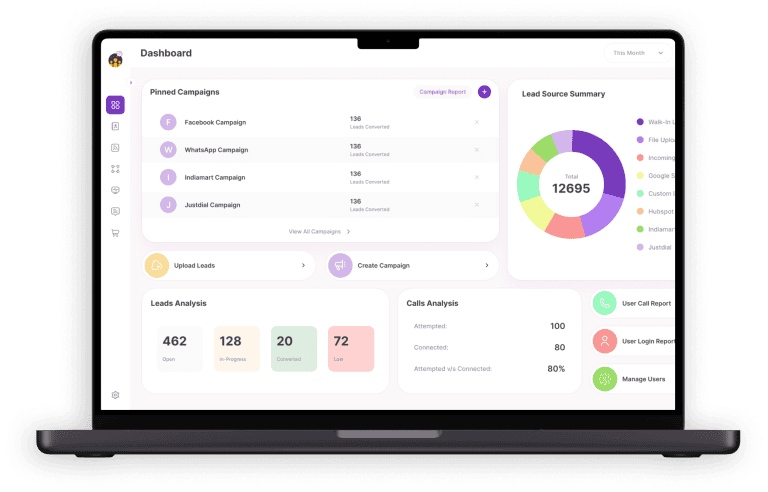
Insurance CRM software collects and stores much data on leads and agents. This data provides useful insights in the form of analytics and reports, which are built automatically inside the CRM.
These analytics are very useful for making business decisions and developing new strategies to enhance customer experience and boost agents’ productivity.
Insurance agents (claims) must always be active because customers may come up with claims-related queries at any time. Having an insurance CRM solutions that supports smartphones can be a lifesaver for these agents who work remotely or are on the go.
Multi-channel engagement is an extremely important feature of CRM for insurance agents. This feature is useful as you can send emails, SMS, or WhatsApp messages on social media.
You can bulk send messages, and through these bulk SMS, WhatsApp, and Emails, you can target your potential customers and convert them.