

Valid till
Hrs
Mins
Secs
Valid till
Hrs
Mins
Secs

What Is PSTN and How Does It Work?

What Is PSTN and How Does It Work l NeoDove

In a world before smartphones and Wi-Fi, people used to rely on an almost magical thing called PSTN to communicate. 

While it may sound like an ancient relic from the past, the Public Switched Telephone Network is actually still in use today. Moreover, it continues to play a vital role in how we communicate.

PSTN is a method of communication that has come a long way since its introduction. And, it continues to remain an important part of our daily lives.

In this article, we will dive into the fascinating world of PSTN and learn how it works and more. So, sit back and let us unravel the mystery of Public Switched Telephone Networks together!

What is PSTN?

Public Switched Telephone Network (PSTN) is defined as a traditional circuit-switched landline telephone network. 

PSTN is made up of every switched telephone network around the world that’s operated by international or local carriers. These networks serve as the infrastructure for public telecommunication. 

What is PSTN - NeoDove

Since the 1800s, operating using underground copper wires, PSTN systems have been in use. In fact, PSTN has served as a reliable method of communication for households and businesses alike for many generations. 

The phones used are known as Plain Old Telephone Service (POTS), PSTN landlines or fixed-line telephones. While still in use and widely accepted, PSTN phones have seen a noticeable decline over the past decade. 

How does PSTN work?

A Public Switched Telephone Network is actually a combination of various networks used across the world. This includes fiber optic cables, telephone lines, cellular networks, switching centers, satellites as well as cable systems. With a PSTN system, users are able to place landline telephone calls.
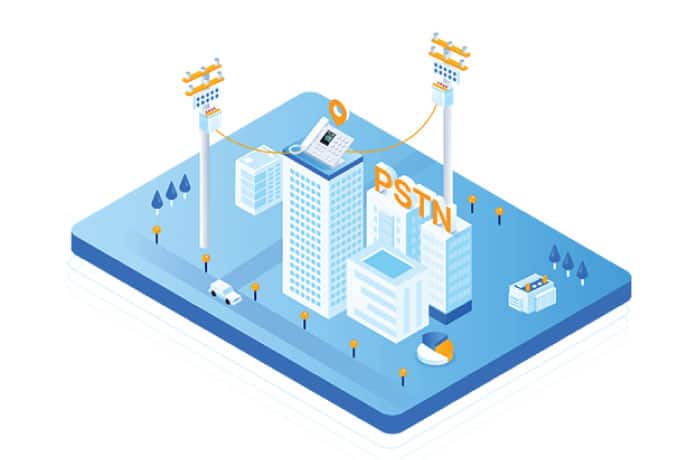
How does PSTN work - NeoDove

Public Switched Telephone Network systems are made of switches placed at centralized points on a network. These allow for communication to occur between two points on a network. Thus, a call is made after being routed through different switches. In this way, your voice signals are able to travel through the connected phone lines.

Here’s a step-by-step breakdown of how PSTN works:

Step 1 – Converting call to electrical signals

Here, your telephone first converts sound waves into electrical signals. These signals are then sent to a terminal using a cable.

Step 2 – Transmitting signals to a CO

At this terminal, your electrical signals are collected and then transmitted to a central office (CO).

Step 3 – Routing your call through fiber optic cable

At this central office, your call is then routed through fiber optic cable. This fiber optic cable then carries your electrical signals to their destination, in the form of light pulses. 

Step 4 – Redirecting your call

Then, your call is directed to a tandem office or a central office (in the case of local calls). 

Step 5 – Converting call back to electrical signals

After reaching the correct office, these signals are then converted back to an electrical signal and finally routed to another terminal.

Step 6 – Connecting your call with recipient

Lastly, this terminal routes your call to the correct telephone number. When the recipient’s telephone gets the call, it then converts the electrical signals back to sound waves. 

Thus, this whole process results in nearly instant communication between callers.

The Advantages of Public Switched Telephone Network (PSTN) Systems

PSTN can be a helpful form of communication for your business. Some advantages of PSTN networks include:

1) Reliability

PSTN does not depend on an internet connection. As such, if a power outage or network crash were to occur, your business could still continue making calls uninterrupted. 

Important Tip 

Ensure uninterrupted communication during outages by having a backup power source, like a generator, for your PSTN system.

2) Usability

A PSTN system is fairly easy-to-understand and use at work. This is especially helpful for people who are unfamiliar with newer technology. You can use basic features like voicemail, call forwarding, muting, etc.

Important Tip 

Simplify staff training on basic PSTN features by using visual guides or infographics, aiding those less familiar with modern tech.

3) Security

The Public Switched Telephone Network uses underground copper wires to operate. This makes it almost impossible to hack into and makes PSTN a very safe and secure option for businesses/ individuals. 

Important Tip 

Enhance PSTN’s inherent security by updating equipment regularly, implementing encryption for sensitive calls, and educating users on security best practices.

The Disadvantages of PSTN Systems

While Public Switched Telephone Network does have its benefits, it is also steadily seeing a decline in popularity. Some of the disadvantages of PSTN networks include: 

1) Cost of system

When it comes to personal use, the cost of a PSTN system is not high. This is because you only need to purchase a subscription for your landline phone.

However, when it comes to purchasing PSTN for business use, it is much higher. This is because every employee will need their own individual line. Installing the telephone lines alongside paying phone bills can prove to be quite financially taxing for small businesses. 

2) Lack of advanced Features

For some businesses, basic calling features like those of PSTN are enough. However, as workforces are evolving, unified communications are gaining more popularity. A Public Switched Telephone Network system is unable to support this. 

Furthermore, PSTN is also unable to provide a means for remote employees to stay connected with customers/ colleagues.

3) Limited Phone Calls

With PSTN, your business must pay for calls or purchase a package with a set number of minutes. Moreover, if you need to place international calls, it can become even more costly.

4) Alternatives to PSTN for businesses

Perhaps one of the biggest threats to PSTN is that it is simply becoming outdated. Many modern businesses prefer to switch to more modern means of communication like VOIP or virtual phone systems

Alternatives to PSTN for businesses - NeoDove

Also read, PSTN vs ISDN: What’s the difference?

Conclusion

Overall, Public Switched Telephone Network systems are a dependable method of communication that is of great help to both individuals and businesses. It’

PSTN is a communication system that has its own set of advantages and disadvantages. While more reliable, it can prove to be more costly for businesses. It is easy to use but may provide only a limited set of features. 

Moreover, PSTN is a method of communication that has been around for a long time. It truly made a difference in the way people communicated and interacted with one another. However, as technology has evolved, so has the need for more efficient communication systems. 

With modern options like VOIP services and virtual phone systems, Public Switched Telephone Networks left much to be desired. For this reason, when choosing a communication system for your business, it’s worth looking into all the options you have. Only then, will you be able to find the best-fit for your business!

Frequently Asked Questions (FAQ’s)

PSTN phones are very helpful in connecting you with team members and customers using fiber optic cables, satellites, cellular networks, etc. However, what makes PSTN an ‘old-school’ system is that it needs you to always have a phone connected to a dedicated voice network.

The three main components of a PSTN system are access, switching and transport.

With PSTN systems, your users are limited to just voice data and basic calling features like voicemail and Caller ID. In comparison, with VOIP, your users can access video conferencing, intelligent call routing, call recording, translation and transcription and other advanced call management features.

Ready to Transform Your Telecalling Operations?

Request Demo l Case Study Page Form l December 2024

By submitting this form, I give my consent to receive message/email/whatsapp and updates to my number or email address

Tired of Wasting Time Dialing?

Boost your telecalling efficiency with NeoDove’s Autodialer. Act now and discover what you’re missing out on!
Request Demo l Exit Intent Pop Up Elementor l October 2024

By submitting this form, I give my consent to receive message/email/whatsapp/calls and updates to my number or email address

Call Smarter,
Close Faster!

100% Lead Capture, 75% More Efficiency, 2X Engagement!

Call Smarter, Close Faster! Form

By submitting this form, I give my consent to receive message/email/whatsapp and updates to my number or email address

Still using Excel sheets Switch to NeoDove

95% business who use NeoDove report 3x more profits!

50,000 +

Happy Customers

4.8

107k reviews

Request Demo l new popup still l june 2024

By submitting this form, I give my consent to receive message/email/whatsapp/calls and updates to my number or email address

Are you Still using Excel sheets for Manual Telecalling?

These outcomes and beyond can be yours.

0%

Lead Leakage

200%

Increase in call attempts

3x

More Engagement
    Request Demo

    By submitting this form, I give my consent to receive message/email/whatsapp and updates to my number or email address